

Is it just me, or did everyone suddenly get a minor in psychology?
We’re all speaking psychological jargon like it’s a second language.
No formal training, just a few three-minute Instagram reels that taught us just enough to sound fluent.
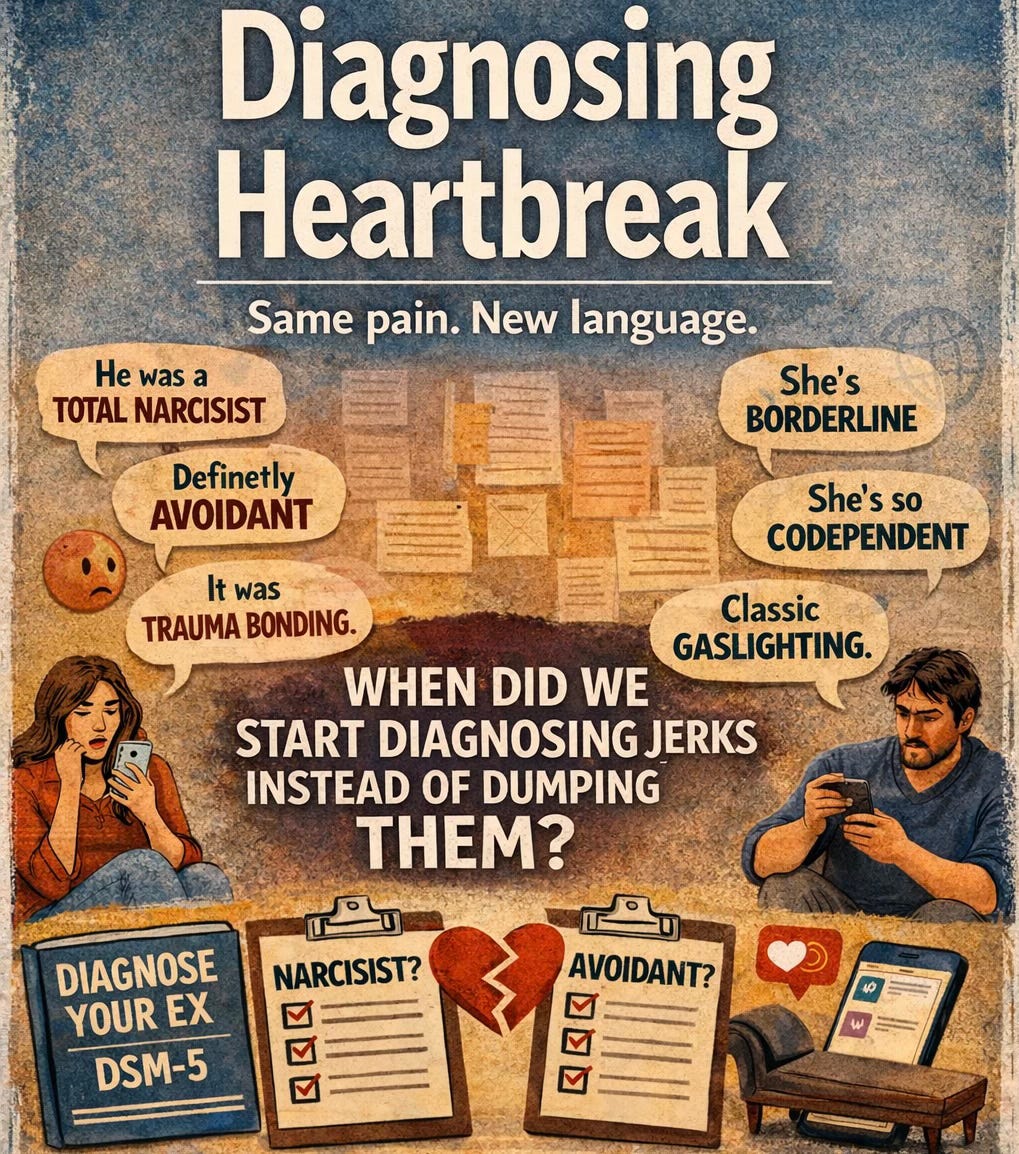
And when did we start diagnosing jerks instead of dumping them?
Open your feed. It’s a coin toss: global crises, political outrage, or someone diagnosing their ex as a narcissist.
We’ve all become insecurely attached or psychologically damaged overnight.
Suddenly, every ordinary hurt is trauma.
Every flaw is a red flag.
Every argument a “trauma response.”
And every bad breakup a story of “narcissistic abuse.”
“She’s crazy, accuses me of cheating and checks my phone,” became “She has an anxious attachment.” Meanwhile, she found three hotel charges on his AmEx while he was “working late” in a city he doesn’t even work in. That’s not anxious attachment. That’s math.
“Last week, she packed my lunches and sent sweet texts. This week, she tossed me the takeout menu and my dry-cleaning ticket and snapped, ‘Get it yourself,’” became
“She’s bipolar.” Or maybe she’s exhausted and wants a partner, not a dependent.
“She’s so needy, three months in, and she wants to see me four nights a week.” became
“She’s codependent.” Or maybe she wants consistency, and he doesn’t want responsibility.
“He spent the whole date talking about himself and his crypto gains” became
“He’s a total narcissist.” Or maybe Bitcoin was up, and so was his ego. Or he’s insecure. Or boring.
“He stayed out until 2 a.m., didn’t call, snapped when I asked, said it ‘wasn’t a good time,’ and now it’s my fault,” became. “He gaslit me.” Or maybe he just didn’t want to take accountability.
“At first, he was full of compliments, spent every night with me, and talked about our future. Now he’s critical and distant,” became
“He love-bombed me.” Or maybe he led with a version of himself that couldn’t last. Or he’s just an asshole.
“Every time we fought, he yelled, put me down, stormed out, came back an hour later, apologized, and promised to change. So I stayed.” became
“I was trauma-bonded.” Or maybe that’s the cruel trick: love, hope, and needing the person who hurts you to also be the one who relieves it.
“He broke up with me, said he couldn’t give me what I need, and was back on the dating apps two days later,” became
“This confirms my core belief that I’m unlovable. My therapist says I need to reparent my inner child.” Or maybe he has commitment issues, and he’s the one who needs reparenting.
And if you ask my exes, I’m probably a walking DSM with a psychology license.
Sometimes I wonder why I went to grad school and spent thousands on therapy when Instagram could’ve taught me how to diagnose narcissism in three minutes instead of five years. And my group chat breaks down attachment wounds over brunch.
When friends turn relationships into case formulations, it feels like I’ve wandered back into supervision… without the grade.
Words like anxious attachment, trauma, and narcissism carry weight. Used with intention, they help us make sense of pain. Used carelessly, they become identities people think they have to repair.
Social media has turned therapy into content. Pain into hashtags. Breakups into disorders.
When every jerk is a narcissist and every mood swing is bipolar, those words lose their meaning.
Labels feel safer than admitting: “I’m hurt.” “I’m confused.” “I loved someone who couldn’t love me back.”
But labels don’t always tell the truth.
Not everything that hurts is trauma. Not every unhealthy relationship is abuse. Not every self-absorbed asshole is a narcissist.
Sometimes, one person cared more. Someone lied. Someone stopped trying. Someone didn’t grow.
Sometimes it’s not “codependency.” It’s loving someone so much, you forgot to protect yourself.
Sometimes she’s not “crazy” or “insecure.” That relationship just brought out the worst in her.
Sometimes it’s not pathology. It’s grief. It’s disappointment. It’s realizing the story you believed wasn’t real.
Before calling someone a narcissist, try saying: “What you did really hurt me.”
Before claiming a “trauma bond,” ask yourself: “Why was leaving so hard?” Before calling them “insecure,” ask yourself: “What role did I play in this?”
Yes, sometimes it really is narcissism, trauma, or abuse. But most of the time, it’s just two people trying, failing, saying the wrong thing, wanting different things, feeling misunderstood, and breaking each other’s hearts.
Not everything is clinical. Some things are just ordinary human behavior.
Such a needed reminder. Not all pain is pathology. Sometimes it’s just heartbreak, not a diagnosis. Thanks for bringing clarity back to the conversation.
Amen to that!! I'm the first one who's interested in psychology but I tend to be very sceptical of people, especially on Instagram, who all they talk about is how to diagnose a narcissist, or "you can tell someone has a personality disorder by these 5 traits", usually most of them spread misinformation and a lot of people fall for it. And sometimes labeling someone become an excuse for not to look at our own behaviour because we're more busy pointing fingers than to look inward