
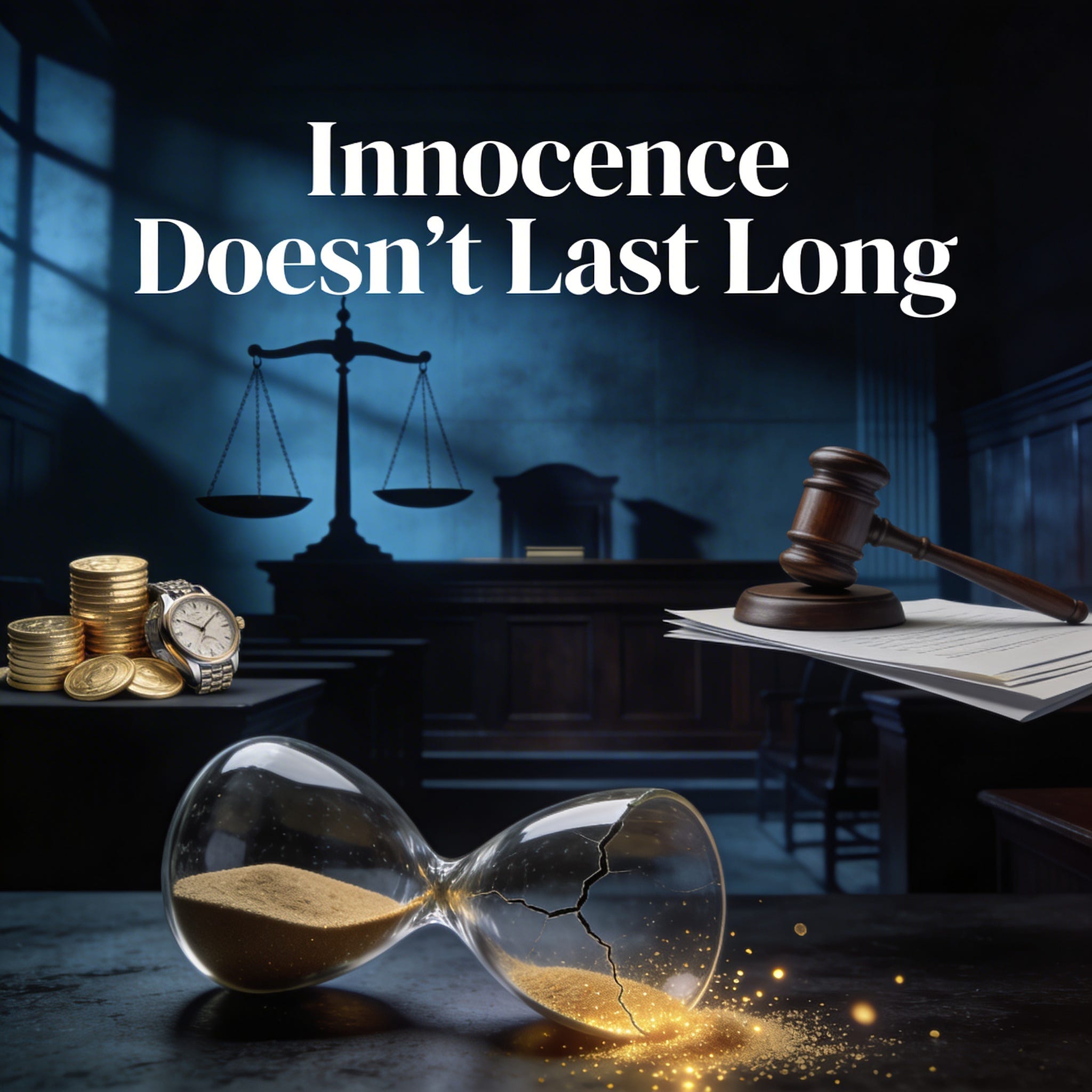
Innocence Doesn’t Last Long
Some people get caught. Some don’t. I get caught for everything.

Some people get caught.
Some don’t.
I get caught for everything.
I used to think consequences were about right and wrong, but they’re really about power: who is watching, who you are, and what resources you have when things go wrong.
So who is luckier: the one forced to rebuild, the one who never gets caught, or the one who can afford to make it disappear?
In high school, a friend slipped lip gloss into my shopping bag. Security ran toward me. Guess who got caught. Back then, petty theft still came with handcuffs.
Twenty years later, my Global Entry application stalled until I proved the matter had been resolved. I’m thinking, do these Global Entry people watch the news? These days people walk into Nordstrom wearing masks, grab armfuls of merchandise, and leave like it is a casual errand. Meanwhile, I am flagged at an international border over a twenty-year-old lip gloss.
I grew up thinking rules were negotiable. I wasn’t entirely wrong. Two people can make the same mistake and pay very different prices.
There was a teenager in Texas who drove drunk, killed four people, and his defense blamed “affluenza.” Probation followed.
I’m thinking, are we diagnosing wealth now?
Apparently privilege becomes a diagnosis when you are too wealthy to understand consequences.
If they were poor and claimed they did not understand consequences, no one would invent a diagnosis. They would call it a crime.
That is the real equation of justice in America: luck and timing, multiplied by status.
I got a DUI in 2009.
I did not hurt anyone.
I hired a very expensive lawyer.
I still spent two days in Tucson jail.
An hour there is enough to cure affluenza.
Seven women, one cell: robbery, attempted murder, narcotics, and me. Peanut butter and honey sandwiches on Wonder Bread. Autonomy disappears fast. Stand. Sit. Eat. Sleep. Chores. Mine was toilet duty. Cleaning a toilet shared by seven women was not included in my plea agreement.
Do you know you have to pay to be in jail? I paid $1,800 for what felt like boarding school for criminals. You would think housekeeping was included.
Even after the sentence ends, the consequences don’t.
Power doesn’t just shape consequences. It shapes credibility.
In court, the abuser who stays calm and composed is often perceived as stable, while the survivor who is visibly emotional is labeled reactive. Composure is mistaken for credibility. Emotion is mistaken for instability. One leaves with custody. The other leaves with supervised visits and a list of services to complete before being trusted with their own child.
Trauma becomes evidence against the person who survived it.
Some punishments don’t fit the crime.
Some do.
And some crimes never face consequences at all.
Stability feels permanent until it isn’t.
I’ve faced consequences that were unfair, public, and permanent.
People call it a learning experience, something you’re supposed to grow from. But when your reputation, stability, and sense of control are at risk, no one thinks today feels like a great day for personal growth.
The first thought is survival. Denial. Justification. Negotiation.
Money buys lawyers and time. It softens consequences. Sometimes it makes them disappear. But avoidance has an expiration date.
Money isn’t the only risk factor. Having nothing can feel like having nothing to lose, which can be just as dangerous.
When people get caught, support often turns into surveillance. We monitor instead of mentor and call compliance change. Under constant observation, behavior does not disappear. It adapts. Risk becomes quieter, not smaller.
I’ve learned compassion depends more on the life experience of the person deciding your fate that day than on the crime itself.
You just hope they have lived enough to recognize themselves in you before they decide your outcome.
Ah, what an eloquent reflection on our inefficient and broken system.
I was a criminal defense investigator for well over a decade, in multiple states and jurisdictions. I mostly worked with public defenders whose clients are perceived as the lowest of the low by society in general.
But, just as you touched on, the trauma so many of our clients had endured in life would also be unfathomable to society in general. It was our job to be in their corner, sometimes the first people to ever fight for them.
Of course, I also sat across a table from evil given physical form. But that was rare. I met so many wonderful people, strong, funny, resilient and smart. They were just in the wrong place at the wrong time, born disadvantaged, in the wrong neighborhood or to the wrong parents and the system did the rest.
What you wrote about here is part of the reason I don't do that work anymore. Day in and day out trying to show that everyone is more than the worst day of their lives only to have prejudice and bias win out without a moment's consideration. It's heartbreaking.
Sorry for the ramble, you got me in a head space I haven’t touched in years and I just had to throw my voice in with yours.
Thank you so much for sharing. You write very well.
This echos your experience! The woman concerned has been subjected to horrific systems abuse first for fleeing a DV situation, then for complaining about getting no help and having her child stolen for her without court orders or just cause!
https://matildabawden.substack.com/p/when-sheer-disbelief-makes-the-mental?r=ty9az&utm_medium=ios